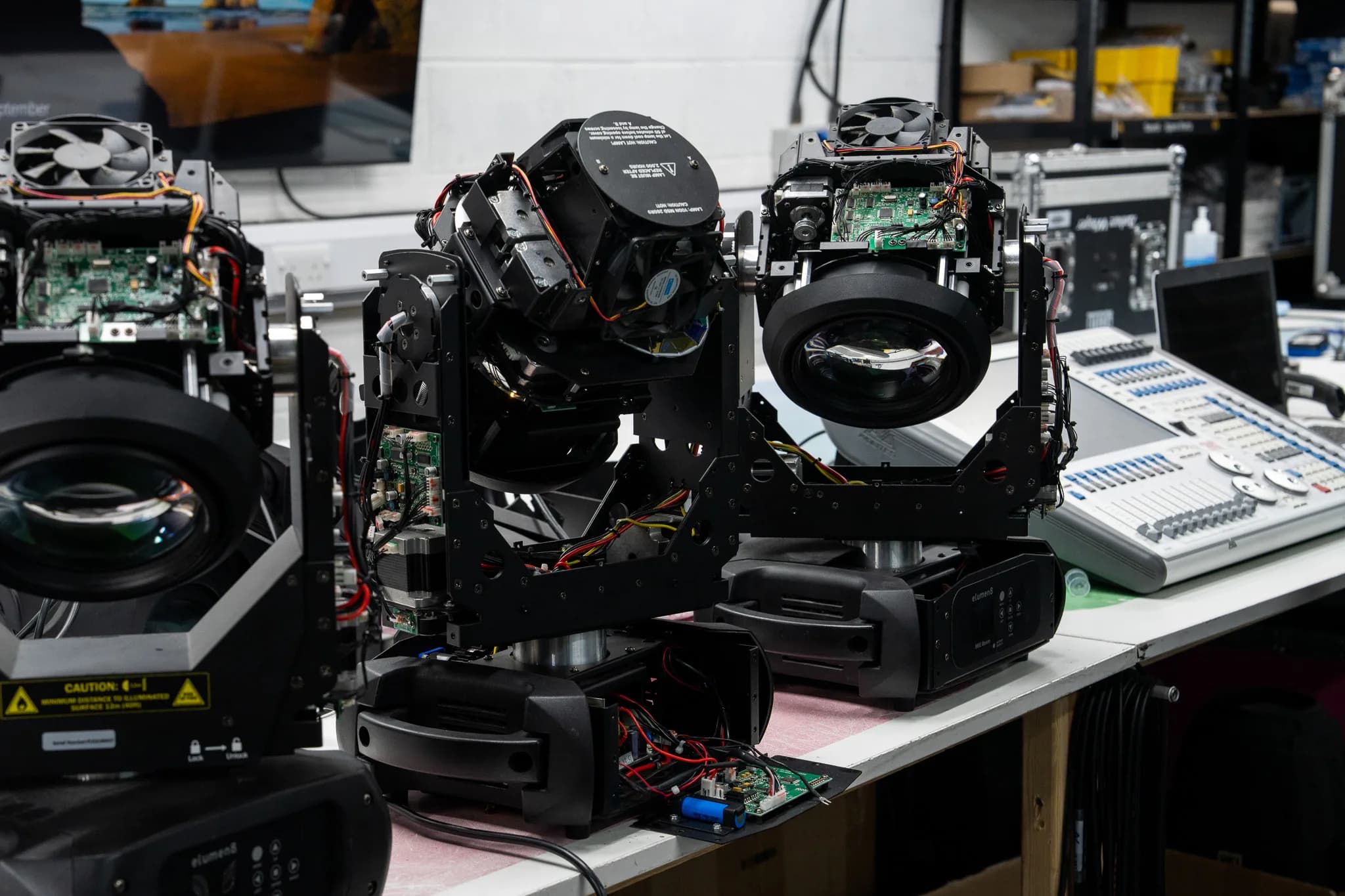
Our moving heads dim down and reset themselves partway through a show.
Moving head overheating and resetting: time the failure
Thermal cutouts and mid show resets are usually a cleaning job rather than a board fault. Triage by timing, then set intervals per fixture.
- Usually
- Choked filters and haze residue matted across the intake
- Check first
- Every fan spinning at power up, then the temperature log
- Fixable
- Fans, filters, sensors, belts, drivers, optics
- Where
- Touring stock to the bench, house rigs on site
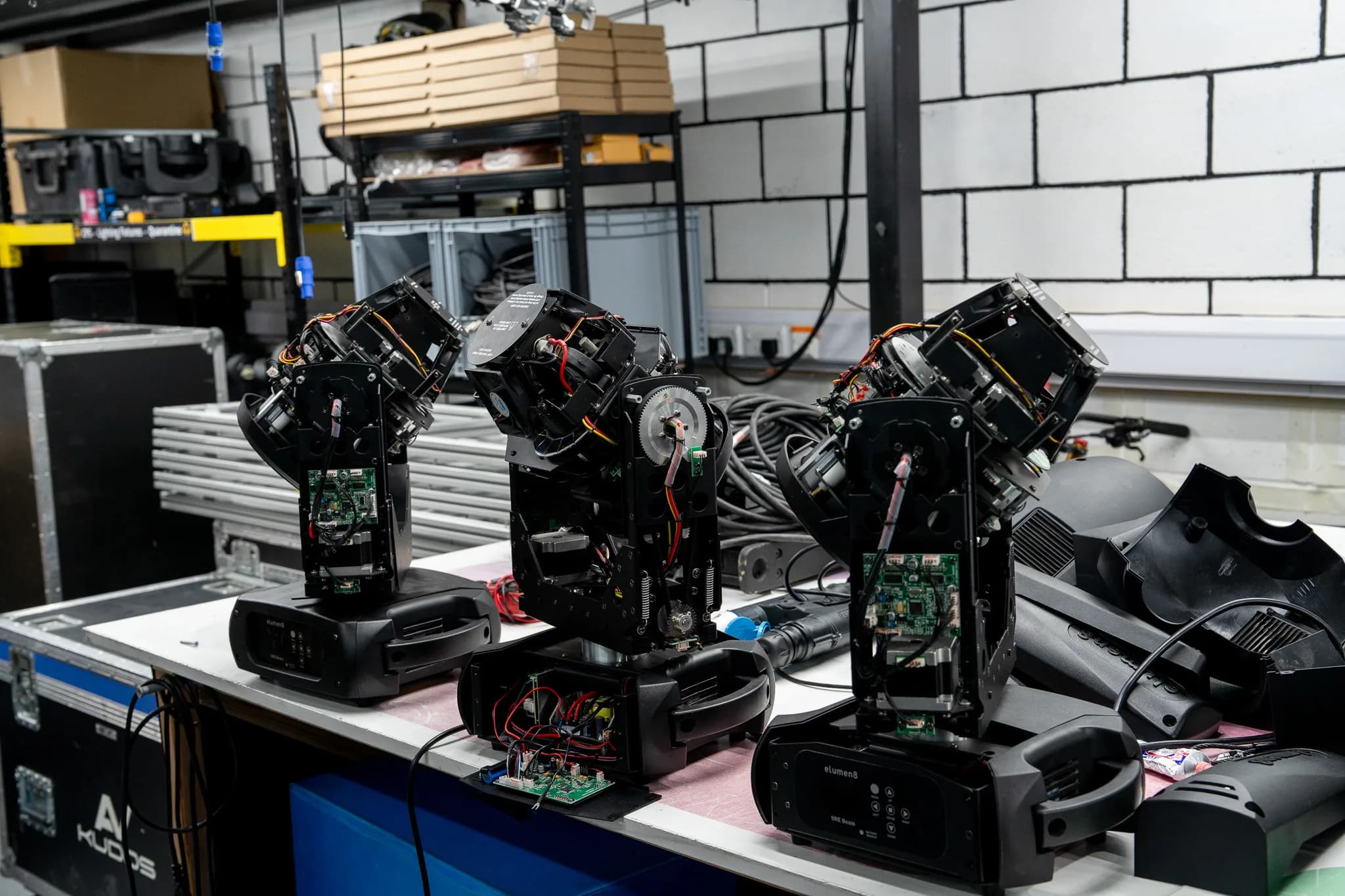
A moving head overheating and resetting at minute twenty five, then behaving perfectly through the next soundcheck, has already told you what's wrong. Airflow. Pull the base cover and you'll usually find a grey felt mat sitting across the fan intake. Haze residue pressed into airborne fibre until it's a blanket, and no amount of compressed air will lift it.
Nothing's broken in there. The fixture is suffocating, and the firmware is doing precisely what it was written to do.
A moving head overheating and resetting: time the failure, don't read the code
Current heads carry temperature sensors on the source and on the driver board, often on the mains supply as well. Cross the first threshold and output drops. Past the next one, the source goes out. Keep climbing and the head resets to try and save itself.
So the clock is your best instrument. Thermal faults arrive twenty to forty minutes into a run and get worse the higher the head hangs on a warm truss. Same fixture, cold venue, and it's faultless. A failing power supply has no warm up period at all: it drops the whole unit from cold, first time, with nothing useful in the error history.
On our bench we've had heads tagged as PSU faults run six hours in an open workshop without a flicker, then cut out in eighteen minutes once we boxed them into a case. (Nothing had changed except the air around them.)
Some of these don't get another power up
Burning smell or visible smoke. Severe grinding from the pan or tilt drive. Scorched connector, damaged mains wiring. Quarantine it, label it, and don't let anyone plug it in to check.
Quarantine means something physical rather than an intention. Tape over the inlet. Tag the head with the date, the symptom and whatever the error history gave you. Then keep it off the racked stock, so nobody in a hurry grabs it as a spare. A head that has cooked one connector will cook another, and it'll do it in front of an audience.
One more belongs on that list: a moving head overheating and resetting again after a proper clean. If the airflow path is genuinely clear and the head still cooks, something is either making heat it shouldn't or refusing to move it. Three candidates cover most of them. A fan controller that no longer ramps the fans up with temperature, a sensor reading high against reality, or a source degraded far enough that it runs hot for very little light.
Sort that on the bench rather than in the roof. Force each fan from the service menu and confirm it actually changes speed on command, because a fan that spins at power up can still be stuck at its minimum. Then log live temperatures at idle and at full output over twenty minutes. A reading that climbs and never plateaus is a cooling problem you haven't found yet. One that plateaus low and still trips the cutout points at the sensor, its thermal path, or a loose heatsink fixing after a drop.
Keep the numbers. Two temperature logs from the same fixture, one before the clean and one after, settle most arguments about whether the head is fit to go back out. If the second log looks like the first, the head hasn't been fixed, it's just been dusted.
Ambient matters more than crews expect. Manufacturers give a maximum operating ambient for each platform, and a position boxed into a truss under a summer roof sits well above whatever the room reads at floor level. Measure the air at the fixture before you condemn the fixture.
Clicking and resets that never complete are a different path. Our guide on pan motor grinding and drift walks it through. Worth deciding in advance who in your building is allowed to open a fixture at all, and the HSE guidance on electrical safety helps you draw that line.
Before you strip anything
Order matters, because most of these heads want a brush rather than a bench.
- 1.Read the menu first. Live temperatures and the error history. Write it on the job sheet.
- 2.Power up and watch every fan spin. All of them, straight away. Listen for ticking, or a fan that starts then stalls.
- 3.Torch on the filters and the intake gauze. Hold a sheet of paper near the intake with the fixture running. No pull, no air.
- 4.Dim rather than hot? Clean the front optics before you blame the source. Haze film on glass costs real output and looks exactly like a tired engine.
- 5.If it won't move, reset it and check your data. Bad DMX and a failed reset look identical from front of house.
- 6.Look up at where the thing hangs. Boxed inside a truss or sat above a smoke machine, it'll cook whatever you do to it.
Intervals that stop a moving head overheating and resetting
No published universal cleaning interval exists for a moving head, and anyone who quotes you one has made it up. Derive yours from logged hours and haze exposure, then adjust for how hard the stock travels. A festival head off the back of a truck and a fixture hanging in a clean auditorium don't live in the same world.
Three tiers, applied per serial number.
Every return to the warehouse. Ten minutes a head, done by whoever unloads. Power up, run the reset, watch the fans, check the filters, wipe the lens, log the hours. Anything that fails goes into quarantine before it can go back in a case. That habit on its own catches most of our thermal work before it becomes a repair.
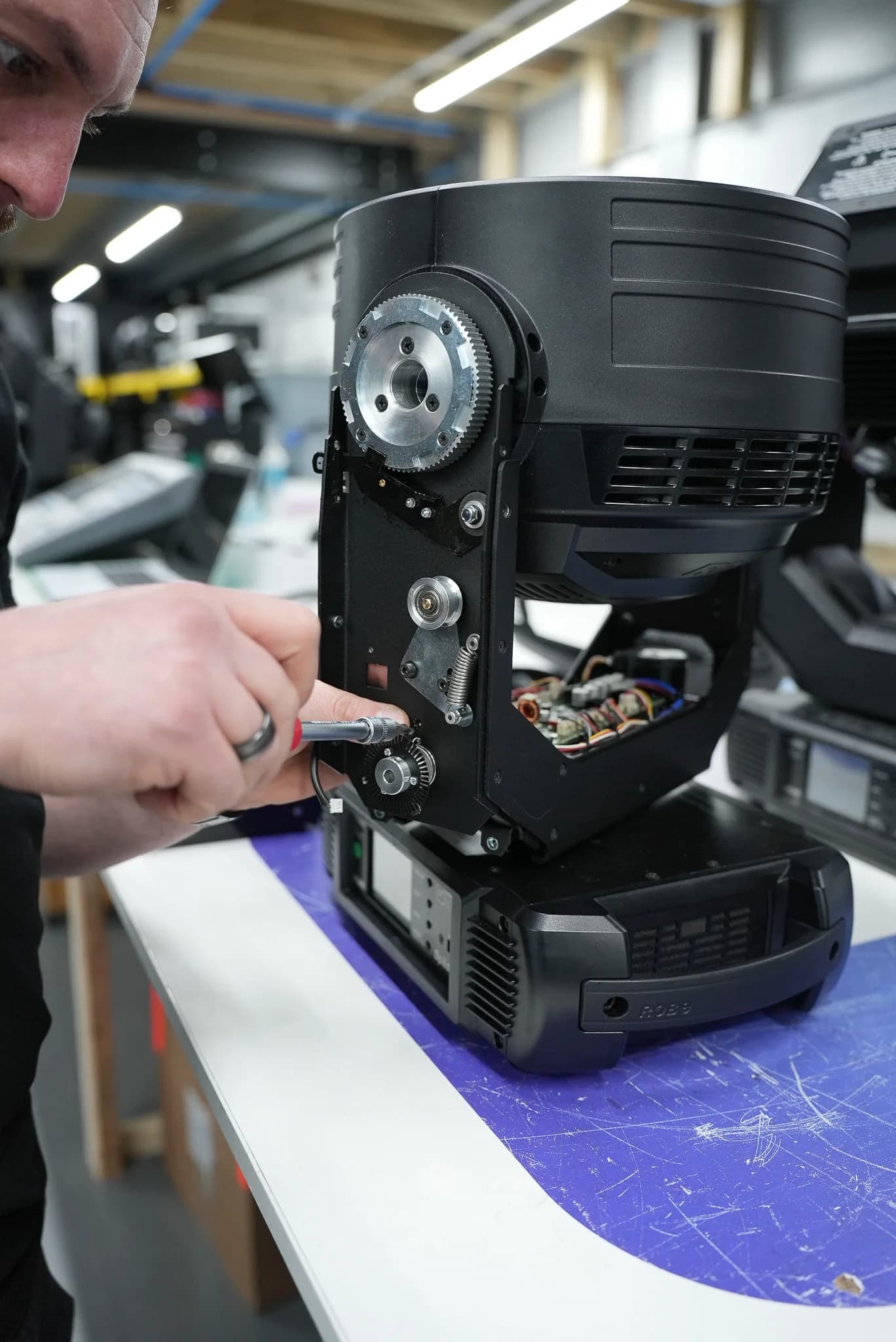
Per run, or every few hundred hours in haze. Covers off. Filters washed or replaced, fins cleared, fan blades cleaned properly, because a dirty blade sits out of balance and takes the bearing with it a few months later.
Colour wheel and gobos next, then the internal optics. Check belt tension, and look underneath the pan and tilt drives for black dust, which is a belt shedding into the base. Running BMFL? Robe tilt belts are a known wear item, so start there.
Annually, or after a heavy touring season. Full strip. Bearings, sensor brackets, wiring looms, connector pins, base PCB, then a complete recalibration of pan and tilt. Chafed looms and corroded tilt sensor pins turn up at this level. They're the faults that would have ended a show rather than dimmed one.
Two cautions on the deep work. Lubrication intervals mostly aren't published the way they are for mechanical plant, and the numbers you need are model specific: torque figures, belt tension, sensor gaps, lubricant type. Get them from the manufacturer's own service documentation rather than a forum thread. Robe publish service and user material for their platforms, and grease that suits one yoke will destroy the bearing in another.
Photograph everything before it comes apart, and that's the second caution. Belt routing and cable tie points. Thirty seconds of phone work saves you an hour on a head you only open twice a year.
House rigs play by other rules. Fixtures over a bar or near a kitchen extract pick up grease as well as dust, and grease holds dust in place. So we service house rigs in venues on a calendar interval instead of an hours interval.
Nobody's logging runtime on something that's been in the ceiling since 2019. Annual is the floor. Make it semi annual if the room gets fogged every week.
Then log it against the serial number, never the case. Hours, last clean, filter changes, faults, calibration dates. When you're picking twelve heads for the next run, you'll want to know which ones have done four hundred hours in smoke since March. Clients on a servicing retainer get that schedule built around their real show calendar, because a fleet that works every weekend in autumn wants attention in February.
What we fix, and what we'll talk you out of
Fans, filters, belts, bearings, position sensors, drivers, supplies, looms and optics are routine moving light servicing. Recalibration after somebody else's repair arrives more often than you'd expect.
What won't come back is a source that's run hot for two years on a discontinued platform with no engine available anywhere, or a casting cracked in a drop. You'll hear that at first assessment (the honest answer, anyway) rather than after the strip down.
Touring stock is better off here, so send it in with the error code and rough timing of the cutout. Installed rigs we'd rather see in place, since half the fault is usually the air around the fixture. Either way, talk to us before you write a head off. Most of the time the cure is a brush and a filter.