The moving light grinds when it pans and it keeps losing its position between cues
Moving head pan motor grinding: why it drifts and what we fix
Grinding, clunking or slow position drift in a moving head is usually the belt, bearing or home sensor rather than the motor. How to tell, and what we can put right.
- Usually
- Worn belt, dry bearing or dirty home sensor
- Check first
- Cable tangle in the yoke, and truss clearance
- Fixable
- Belts, bearings, sensors yes. Cracked yokes rarely
- Where
- Bench strip-down, not a ladder job
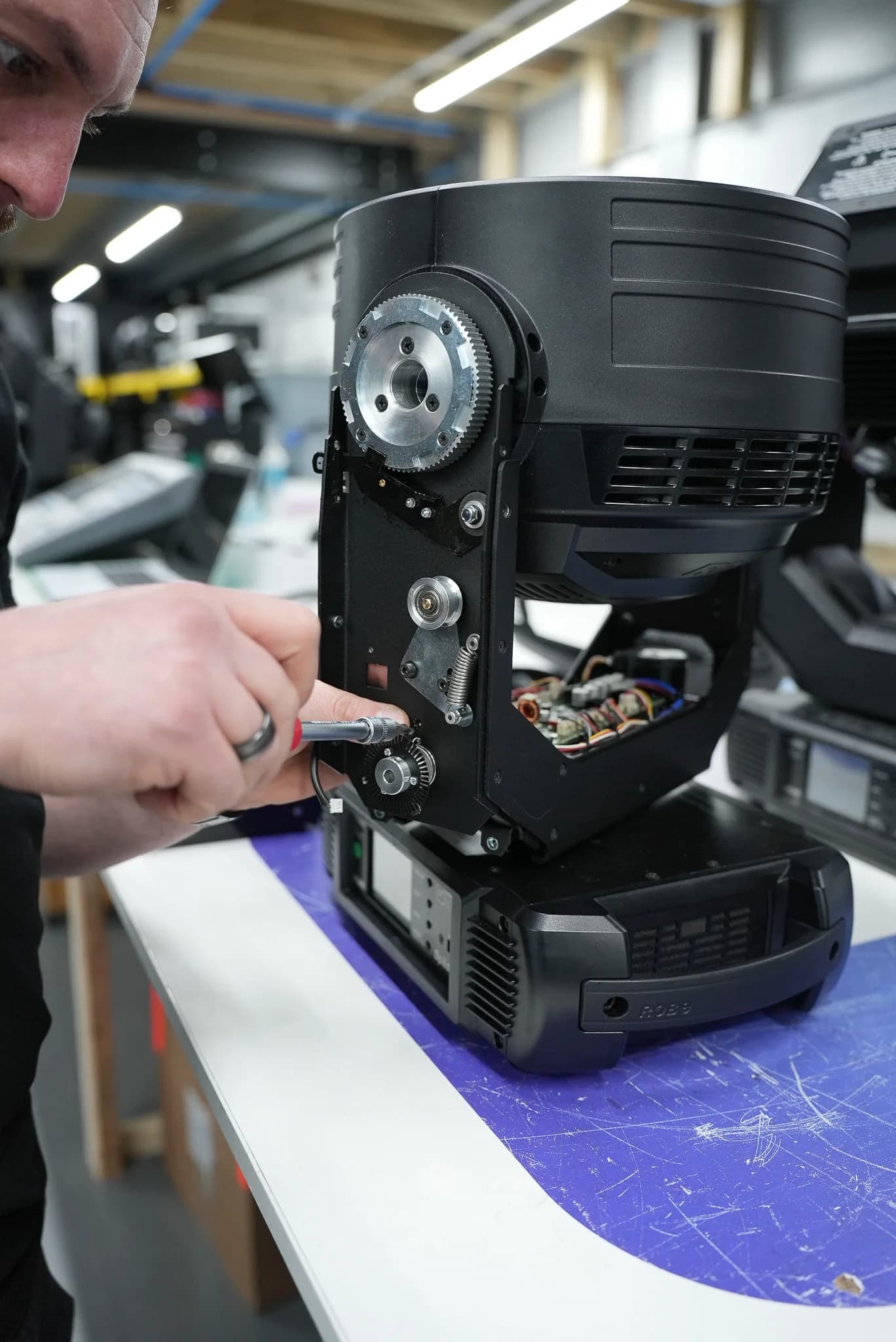
Nine times out of ten the motor itself is healthy. A fixture lands on our bench reported as moving head pan motor grinding, we get the covers off, and what we find is a timing belt with rounded teeth, a home sensor buried under haze residue, or a bearing that's run dry. Spin the stepper on its own and it's smooth. It just can't drag the head through a drive train that's fighting back.
That's the good news for your repair bill, because motors are the expensive part.
Read the display before you touch anything
Most heads tell you which half of the problem you've got, and the exact wording matters.
A pan or tilt error means the fixture can't find home at all. An encoder error means it moved, but the fixture no longer knows where it ended up. A feedback error means the desk sent a command and nothing moved. Sensor errors point straight at a Hall device or an optical sensor that's dirty, unplugged or dead.
Write down which message you saw, and whether it came up at power-up or three cues into a show. We'll ask you that.
What moving head pan motor grinding usually means
The belt. Most pan and tilt drives use a toothed belt between a stepper and a large pulley on the yoke or the base bearing. Teeth wear round, tension drops, and the belt jumps a tooth under load. You hear a hard clunk or a short grind at the same point in the movement every time, and the head comes back a few degrees off. Each home cycle looks fine and each recall is worse than the last.
Bearings and fasteners. Kill the power, then move the head by hand through its full travel. It should be smooth and even the whole way. Stiffness, wobble, a rough patch or a graunching noise all mean the mechanics are no longer giving the sensor clean, repeatable transitions. Loose bracket screws and backlash in a gear train make exactly the same complaint from the front of house position.
The sensor path. Homing works off a small flag or slotted disc passing an optical or magnetic sensor inside the yoke or base. Fog residue, dust and hairspray build a film on that sensor, and a film is enough to blur where home actually is. Manufacturers of touring beam fixtures list dirty optical sensors as a direct cause of jitter and positioning error. If the drift gets worse with every reset rather than staying constant, we look at the sensor before we look at the motor.
No feedback to save you. Pan and tilt on most fixtures run open loop. The driver counts steps out and trusts the head to follow, so any step it loses is gone silently until the next home. Three things cost you steps: load exceeding the motor's torque at speed, over-aggressive acceleration ramps, and a supply voltage sagging low enough to starve torque at high step rates. That last one is why a head at the end of a long, loaded power run drifts when the same fixture is faultless on the bench.
The free fix. Before you condemn anything, look at how the fixture was rigged. Power or DMX tails wrapped through the yoke, or a safety bond looped around a yoke arm, will stop a head dead and leave it humming and grinding against its own cabling. We see it most on installs done in a rush over a truss chord. Tight clearance does something similar: a head that touches a beam or a chord partway through travel will hunt, oscillate and throw a calibration loop that disappears the moment you move the bar. Check that first.
Noise triage. Grinding, rattling or clicking that's new means something mechanical: bearings, loose screws, backlash or a foreign object rolling around inside. A steady buzz or whine with normal movement is usually the driver, its current setting or microstepping, and that's a board level job rather than a strip-down.
Five checks before the fixture goes anywhere
- 1.Give it clearance. Drop the fixture off the truss or move it a metre and run a reset with nothing near it.
- 2.Free the cabling. Unwrap anything routed through the yoke and hang the safety bond from the bracket, never round the arm.
- 3.Power cycle cold, on a supply you trust, with a short mains lead and no dimmer or long distro chain in the way.
- 4.Move the head by hand with the power off, both axes, full travel, listening for the rough spot.
- 5.Run one home cycle and note exactly where in the sweep the noise happens. Same place every time is mechanical.
If grinding still comes back at the same physical position after a clean power cycle and a successful calibration, stop. That's hardware, and further resets won't touch it. (We've had fixtures arrive with forty logged reset attempts on a belt that had already shredded.)
What we repair, and what we won't pretend to
Belts, bearings, home sensors, drive boards and worn pulleys are all standard moving light servicing work. A pan or tilt timing belt is typically a £20 to £30 part. A pan or tilt stepper for a mid-size head runs into the low hundreds, and a driver PCB assembly can be more than the motor. Those are parts costs and they move, so treat them as a sense of scale rather than a quote.
We strip the axis, clean the sensor path properly, replace what's worn, set belt tension to the manufacturer's alignment marks, then run repeated home and position cycles hot before it goes back in the case. Manufacturers who publish proper service documentation make this straightforward: Chauvet Professional and Martin both document belt replacement and base alignment for several of their heads, and we work to those procedures where they exist.
What we can't rescue is a cracked yoke casting, a gearbox that's been run to destruction after weeks of grinding, or a discontinued driver board with no stock anywhere in Europe. Age is the deciding factor, not sentiment. We'll tell you before we spend your money, and you can see the sort of work we finish on our completed repairs page.
Send it in, or get us to the rig
One noisy head in a rack of spares: send it in and keep the show running. A whole installed rig drifting, or heads in a ceiling grid that need scaffold to reach, is different, and for venues it's usually faster to have us on site to triage the lot and take away only what needs the bench.
Either way, tell us the error message and the fixture model when you get in touch. It saves us a day of guessing.
Keeping the rest of the rig off our bench
Clean the sensors and fan paths every three months on anything living in haze. Doesn't need to be elaborate: dry air, a soft brush, ten minutes per fixture. While you're in there, check belt tension and give every visible fastener a quarter turn test.
Log the fixtures that drift, even slightly. A head that needs a nudge on the desk this month is a head with a skipping belt, and belts don't recover. Catch it there and you're buying a belt instead of a motor, a gearbox and a lost show.

