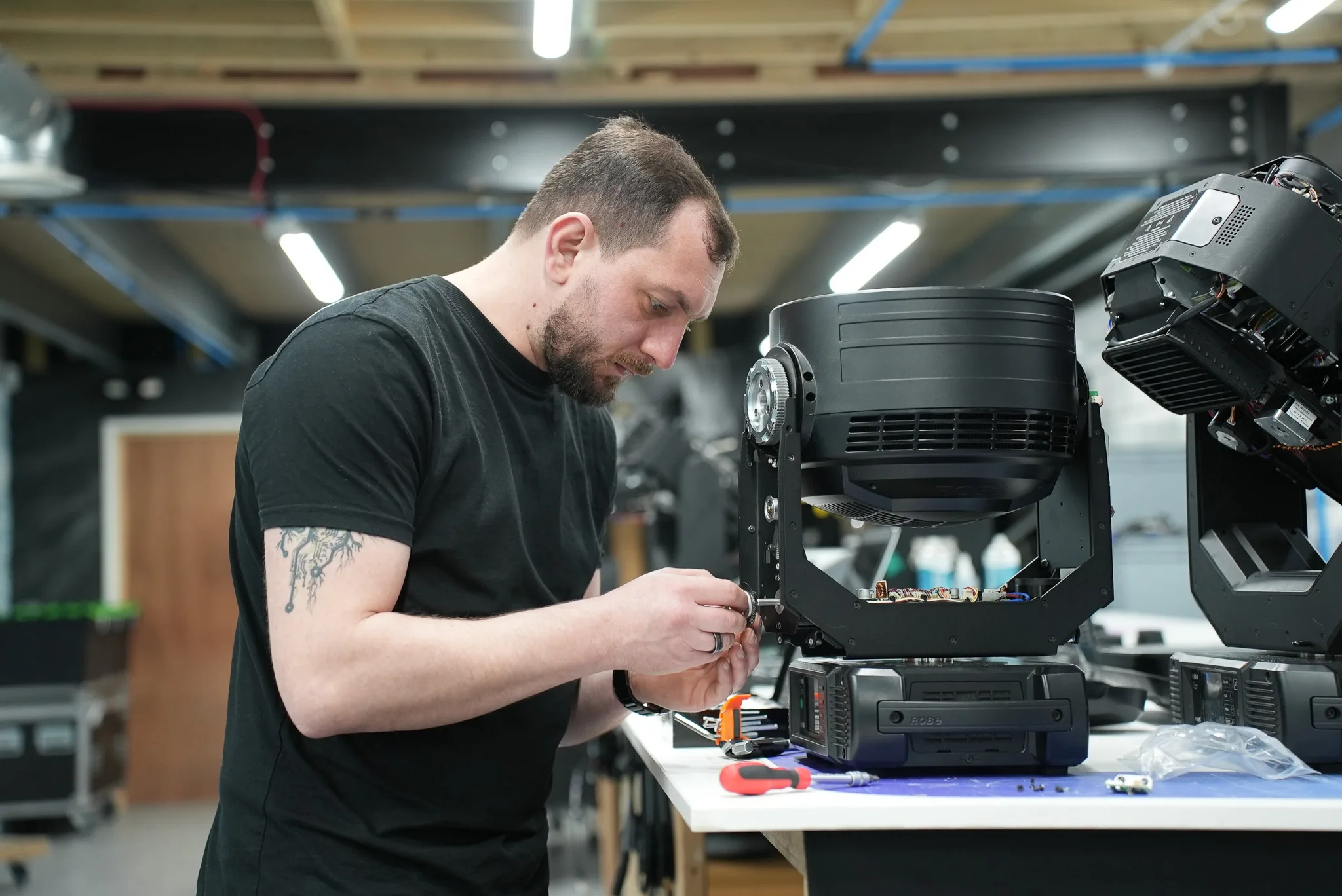
The colour wheel jams between colours or overshoots and comes back, so we get split colours on stage
Moving head colour wheel sticking or stepping past position
Last updated:
A colour wheel that lands half in, half out, or drifts over a show, is usually sticky grease, a loose hub or a blind home sensor. How to tell which, and what we can fix.
- Usually
- Dried grease or a loose grub screw at the wheel hub
- Check first
- Watch the reset and listen for the wheel ratcheting
- Fixable
- Mechanics and sensors yes, cracked dichroic depends on stock
- Route
- Bench work, send in; whole rigs looked at on site
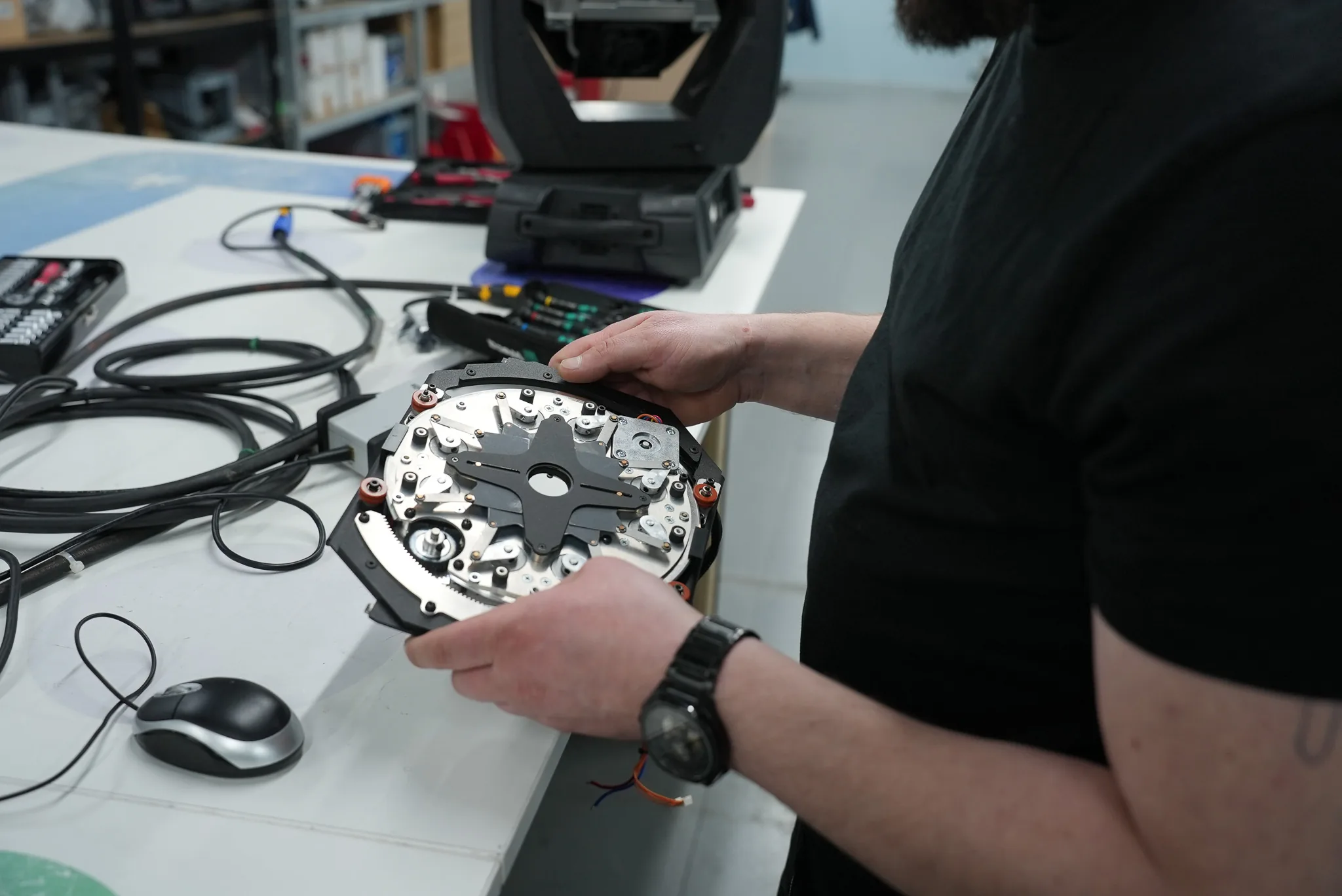
Grease goes off. That's the short version of most of what reaches us as a moving head colour wheel sticking fault: lubricant that's spent years cooking a few centimetres from a lamp or an LED engine, gone from a thin film to something closer to toffee. The motor hasn't failed. It's turning a wheel that fights back, and steppers don't warn you, they just lose steps. So the colour lands half in and half out of the gate, or the wheel sails past open white and crawls back a beat later.
Electrics and optics account for most of the rest. A home sensor blinded by haze residue. A motor loom chafed through at the yoke flex point. A driver stage that goes weak once the head is up to temperature. On your console they all look the same: a wrong colour, a split beam, or a wheel hunting back and forth before it settles somewhere nobody asked for.
Watch the reset, then drive it slowly
Power cycle the fixture and stand close, with the head pointed somewhere safe. On most moving heads the colour wheel homes early in the sequence, before the gobos. A healthy wheel spins up, finds its flag and settles once. A dragging wheel makes a dry ratcheting buzz, overshoots, then has another go.
Plenty of fixtures retry a few times and then carry on regardless. That's why the first colour of the night is wrong and nobody can say when it went wrong. Note any error on the display, and check the fixture's own log if it keeps one.
Now step the colour channel from the console, one slot at a time, all the way up the wheel and back down. Write down where it misses. The pattern you get here decides everything else. (If you have a second fixture of the same type, run it alongside. Two minutes, and it rules out your patch and your profile.)
Moving head colour wheel sticking in one slot, or drifting everywhere?
Four patterns, and they point at four different jobs.
It fails at the same physical slot, in both directions. That's mechanical. Something binds at that part of the rotation, or a filter is chipped and catching, or a retaining ring has backed off so the glass sits proud of the disc. With the fixture off and cool, turn the wheel by hand. Even drag the whole way round is normal. A notch isn't.
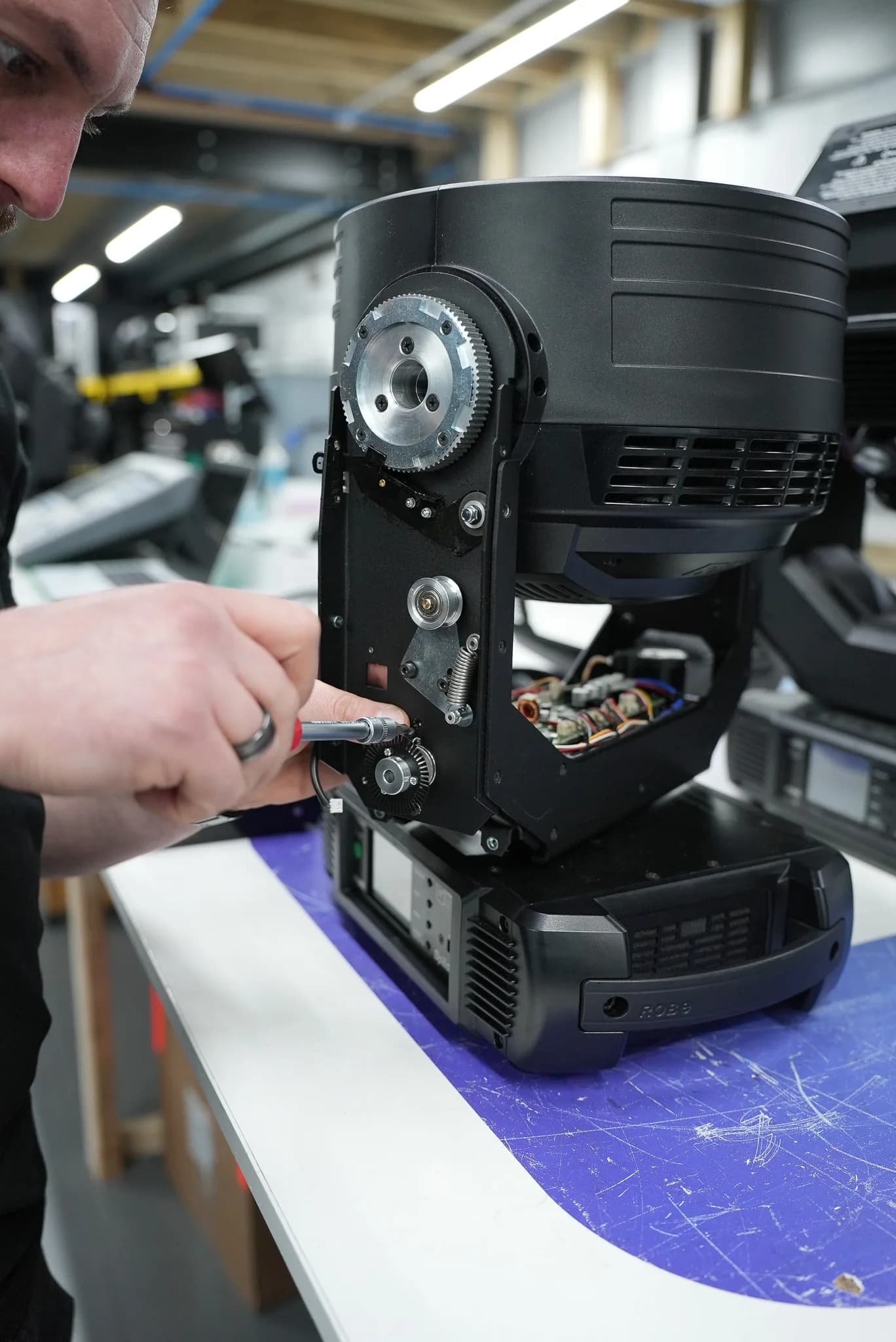
It drifts progressively, worse after a fast colour chase. That's registration, not drag. The motor is stepping and the wheel isn't going with it. Hold the wheel and rock it gently against the motor shaft. Any lost motion at the hub means the grub screw has backed off, or the flat on the shaft has worn round and the screw has nothing to bite. Check that first. It's one of the most common things we find in a head, and once you know where the screw is, it's a few minutes with a hex key.
Every colour is out by the same amount. That's homing. The fixture referenced off something that isn't the real flag, so the whole wheel map shifted by a fixed offset. Look at the slotted optical sensor the flag passes through. Haze residue and fibre pack that slot solid over a few seasons. Check the flag isn't bent and the sensor plug hasn't walked out of its header.
It only misses once the head is hot. Time it with a stopwatch across a couple of shows. A fixture that behaves cold and starts dropping steps after half an hour is telling you about current, cooling or a driver that's derating, which puts it in the same family as a moving head that overheats and resets. Clogged filters and a tired head fan show up here long before anything burns.
One more thing worth ruling out before you pull the fixture from the rig. Colour wheels have discrete slots, and a DMX value parked exactly on a slot boundary makes the wheel dither between two colours. It looks mechanical. It isn't. Check your fixture profile matches the mode the fixture is actually set to, and check nobody has nudged the colour fine tune in the service menu. A fixture that answers RDM will tell you its mode and start address without you climbing anything, which is one of the better reasons to have RDM running on your house rig.
What you can safely do on your own bench
Clean the home sensor slot with a cotton bud and isopropyl alcohol, then blow the dust out. Check the hub grub screw. Reseat the motor and sensor connectors where you can reach them without stripping the optical train. Re-run the fixture's own colour calibration from the service menu, because that routine exists precisely for wheels that have drifted by a step or two.
What we'd ask you not to do: no aerosol lubricants anywhere near the head. Penetrating oil and PTFE spray creep, and they end up on the dichroic coatings and in the gate, where they bake on and haze the glass permanently. Don't lever a stuck wheel round with a screwdriver either. A chipped filter edge turns a cleaning job into a parts job.
If the wheel still binds after a clean, stop there. The grease is inside the hub bearing and it won't come out from the outside.
What we fix, and what we can't
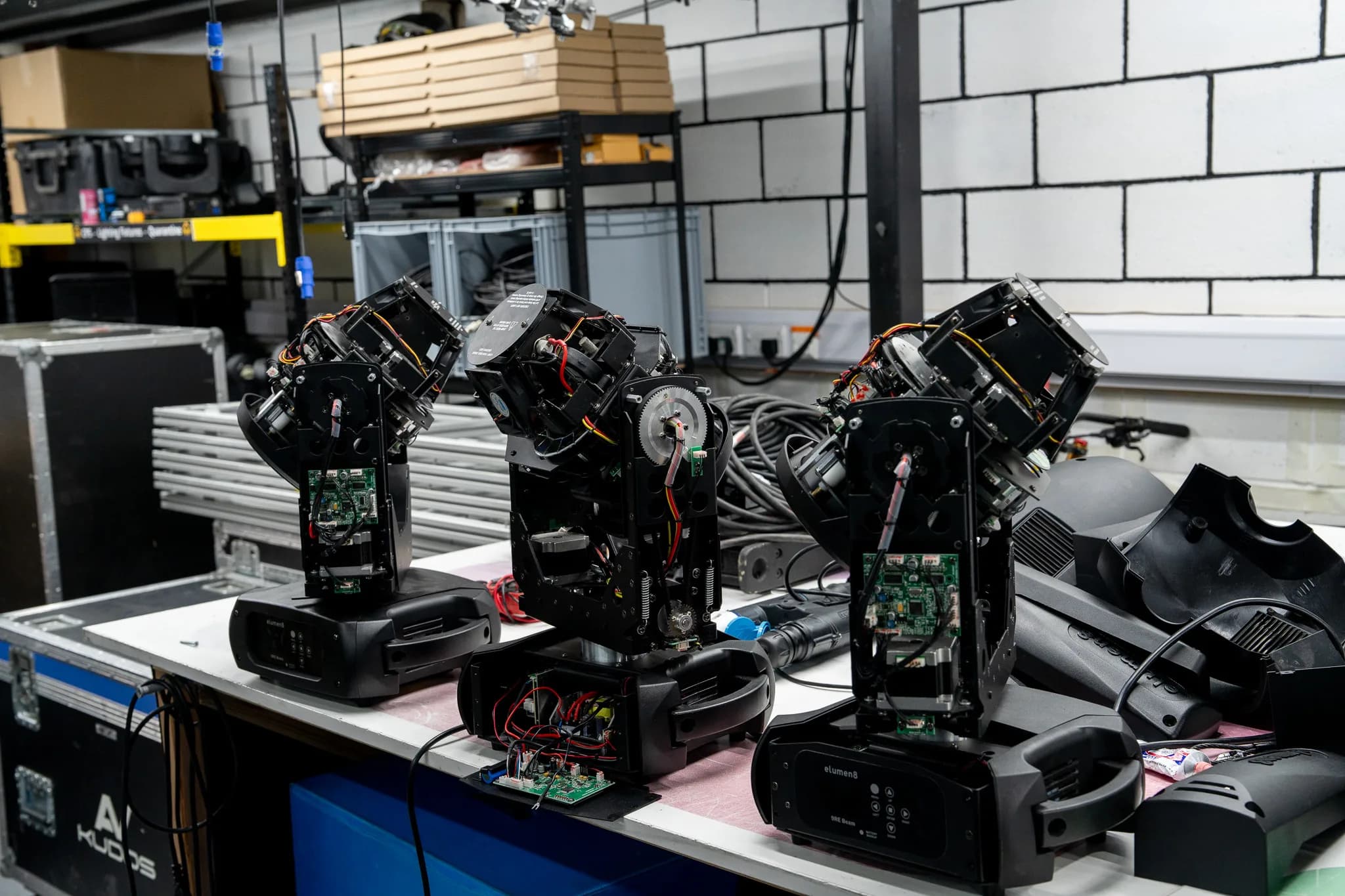
Most of this work is honest mechanical servicing. We strip the head, clean the wheel and the gate, replace the bearing where the design allows it, re-grease with a lubricant rated for the temperature it actually lives at, and replace worn drive belts and tensioners. Chafed motor looms get repaired or replaced at the flex point, not taped. Blind or failed home sensors come out and new ones go in. Where a stepper driver has gone weak we work at component level on the board rather than condemning the whole assembly, which matters on older fixtures. That's the bulk of what we do in moving light servicing.
Then we soak test it hot, with the colour channel chasing, because a wheel that behaves for five minutes on a cold bench proves nothing.
The honest limits: a cracked or delaminated dichroic needs glass, and glass availability depends entirely on the brand and the age of the fixture. Some manufacturers still list individual filters and publish their service manuals openly, Robe being one of the better examples. Others only sell a complete wheel assembly, and some don't sell anything at all once a range is discontinued. A wheel warped by a drop is scrap. If a fixture is bent at the chassis, the colour wheel is rarely the only thing wrong with it, and we'll tell you that before we start rather than after.
Getting a moving head colour wheel sticking fault off your pre list
One or two fixtures is bench work. Pack the head with the lamp out if it's a discharge unit, note which colours miss and in which direction, and send it in with that note attached. The detail saves us an hour of chasing an intermittent.
A whole house rig doing the same thing is a different conversation. When six fixtures in a roof all start stepping past position in the same season, the cause is usually shared: the same haze position, the same run hours, the same batch of lubricant drying out. That's a case for on site work, and it's the pattern we see most in venues where fixtures go up at install and nobody touches them again until something looks wrong from the stalls. Planned servicing on a retainer costs less grief than pulling a rig apart in show week.
Either way, tell us what the wheel does rather than what you think has failed, and get in touch. We'll work it out from the symptom.